
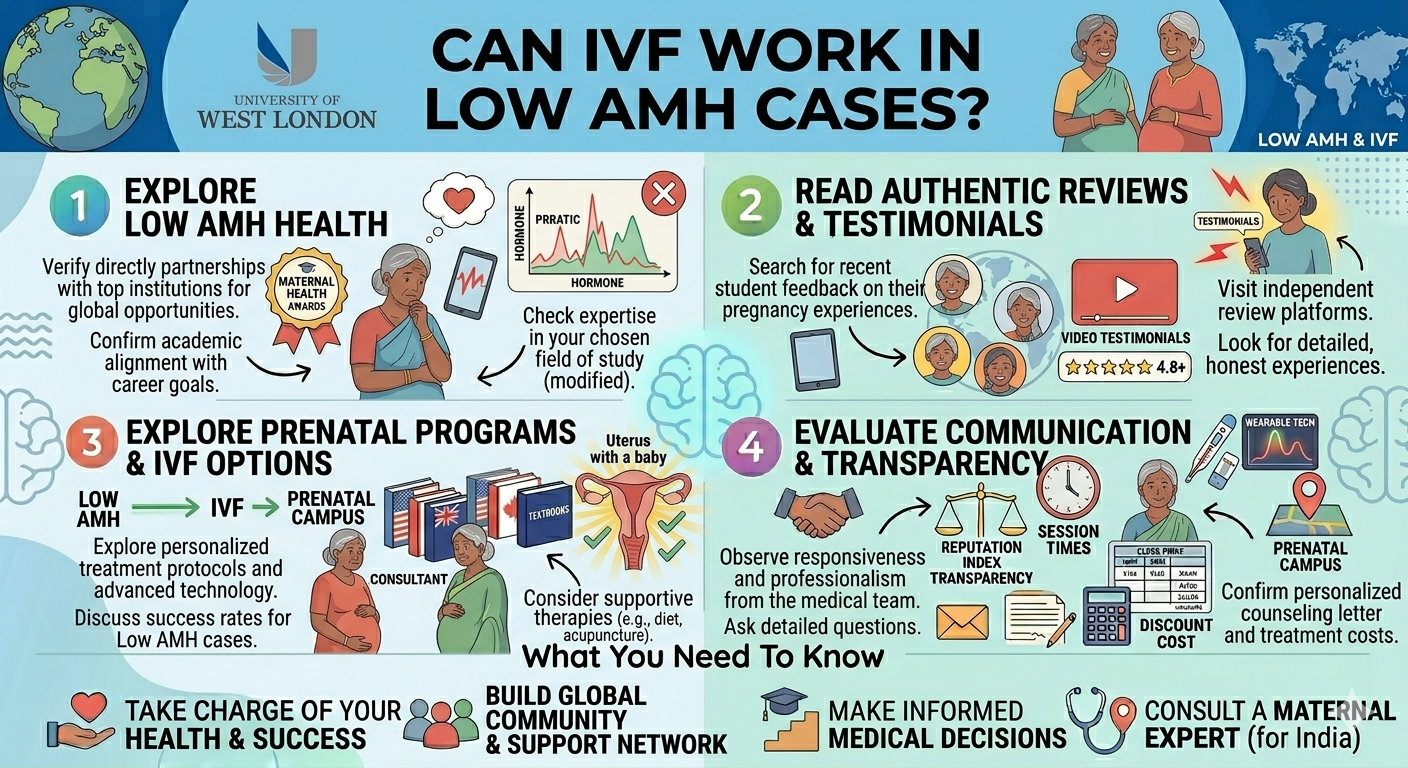

I get this question all the time. A couple walks in. The woman has just gotten her AMH report. It’s low. 0.8. Or 0.5. Or sometimes below 0.3. She’s been crying. She’s convinced it’s over.
And I tell them what I’ve told hundreds of couples before. Low AMH is not the end. It changes the path, yes. But it doesn’t close the door.
Let me explain what AMH actually means, why low numbers don’t tell the whole story, and how IVF still works for many women with low ovarian reserve.
What AMH actually tells you
AMH stands for Anti-Müllerian Hormone. It’s produced by the small follicles in your ovaries. Those follicles are where eggs grow.
A higher AMH means more follicles. More potential eggs. A lower AMH means fewer follicles. Fewer eggs.
That’s it. AMH does not tell you anything about egg quality. It tells you about egg quantity. And there’s a big difference.
A 35-year-old with low AMH might still have perfectly good eggs. Just fewer of them. A 42-year-old with normal AMH might have many eggs, but most of them are chromosomally abnormal. Quantity versus quality.
So low AMH means your ovarian reserve is lower than expected for your age. It means you may not produce many eggs in an IVF cycle. But it does not mean those eggs are bad.
The number itself matters less than the trend
I see women obsess over a single number. 0.6. 1.2. 0.4. They compare with friends. They search online. They drive themselves crazy.
Here’s what actually matters. First, your age. A 30-year-old with AMH of 0.5 has a much better chance than a 42-year-old with AMH of 0.5. Because age affects quality. AMH affects quantity.
Second, your FSH level. If FSH is normal but AMH is low, that’s different from both being abnormal.
Third, your antral follicle count on ultrasound. That’s the number of small follicles visible at the start of your cycle. It’s a more direct measure than AMH alone.
Don’t fixate on one blood test. Look at the whole picture.
How IVF changes for low AMH
Conventional IVF assumes you will produce many eggs. Ten, twelve, fifteen. The doctor retrieves them, fertilizes them, grows them to blastocyst, and picks the best one.
With low AMH, you might produce three eggs. Or two. Or one. Sometimes none.
So the approach has to change.
First, the medication protocol is different. Higher doses of FSH might not help. Some studies show that lower doses or natural cycle IVF works better for low AMH. You’re not trying to recruit more follicles. You’re trying to get the ones you have.
Second, the expectations change. You might only get one embryo. That’s okay. One good embryo has a real chance. Some women get pregnant from a single egg retrieval with one embryo.
Third, you might need multiple cycles. Instead of one big cycle with many eggs, you do two or three smaller cycles. Collect one or two eggs each time. Freeze the embryos. Then transfer them together.
This is called embryo banking. It costs more. It takes longer. But for women with very low AMH, it’s often the best strategy.
What the success rates actually look like
I’m not going to give you fake hope. Low AMH lowers your chance of success per cycle. That’s just true.
But lower is not zero.
A woman under 35 with low AMH still has a reasonable chance. Studies show live birth rates per cycle around fifteen to twenty-five percent. That’s lower than the forty percent for women with normal AMH. But it’s not nothing.
A woman over 40 with low AMH has lower chances. Five to ten percent per cycle. Sometimes less.
But those are averages. Some women beat the averages. Some don’t. The only way to know is to try.
The quality over quantity argument
Here’s something most people don’t understand. In IVF, you only need one good embryo. Just one.
Women with normal AMH produce many eggs. But many of those eggs are poor quality. Especially if they’re older. They get ten eggs, eight fertilize, three become blastocysts, and maybe one is normal.
Women with low AMH produce few eggs. But if those eggs are good quality, you still get one normal embryo. You just skip the waste.
That’s why egg quality matters more than egg quantity. And low AMH does not automatically mean poor quality.
What you can do to improve your chances
There’s no magic supplement that will raise your AMH. Anyone who tells you otherwise is selling something.
But there are things that help.
First, get your vitamin D levels checked. Low vitamin D can falsely lower your AMH reading. Correcting it doesn’t raise your true reserve, but it gives you an accurate number to work with.
Second, optimize your overall health. Good sleep. Stress management. Healthy weight. These don’t raise AMH, but they improve egg quality and implantation.
Third, consider CoQ10. Some studies suggest it improves egg quality in women with low reserve. It won’t work miracles, but it’s low risk.
Fourth, don’t waste time. If you have low AMH and you want a biological child, time matters. Your egg quantity will continue to decline. Don’t spend six months trying supplements and hoping. Get a real plan.
When to consider donor eggs
This is the hard conversation. For some women with very low AMH, especially over 40, the chance of success with their own eggs is very low. Single digits.
At that point, donor eggs become a realistic option. Success rates with donor eggs are high. Sixty to seventy percent per transfer. Because the eggs are young and healthy.
I’m not saying you should give up on your own eggs. That’s a personal decision. But I’ve seen couples spend years and lakhs of rupees on cycle after cycle with no success. At some point, you need to look at the data and make a hard choice.
The emotional piece nobody talks about
Low AMH hits women hard. They feel broken. Less than. Like their body failed them.
That’s not true. AMH is a number. It’s not your worth as a woman or a future mother.
I’ve seen women with extremely low AMH get pregnant. I’ve seen women with normal AMH go through multiple failed cycles. The number doesn’t decide your story.
But the emotional toll is real. Get support. Talk to your partner. See a counselor if you need to. Don’t go through this alone.
Where to get proper care in Delhi
If you have low AMH, you need a doctor who understands the nuances. Not someone who puts you on a standard protocol and hopes for the best.
In East Delhi, you can find the Best IVF Doctor in Preet Vihar Delhi who specializes in low reserve cases. Ask them specifically about their experience with low AMH. How many cycles have they done? What protocols do they use?
And for a full evaluation of your situation, look for Female Infertility Treatment Preet Vihar, Delhi that offers a complete workup. AMH, FSH, antral follicle count, and a thorough history. Not just a prescription for supplements and a pat on the head.
The bottom line
Low AMH makes IVF harder. It lowers the odds per cycle. It might require multiple cycles. It changes the approach.
But it does not make IVF impossible. Women with low AMH get pregnant every day. With their own eggs. With the right protocol. With patience and persistence.
Know your numbers. Understand what they mean. Find a doctor who knows how to treat low reserve. And don’t give up based on one blood test.
The only way to know if IVF will work for you is to try. Not to Google. Not to ask friends. To try.
